
What AI Is Actually Good At
AI has earned a real place in jewelry retouching - not because it replaces skill, but because it handles the tedious, repeatable work faster than any human can. Here is where it consistently delivers.
Key takeaways
- AI background removal cuts hours from large batches, but every mask needs a manual check
- Metal tones and gemstone color must always be verified against the physical piece
- AI spot cleanup works well for dust and smudges; use a light touch on textured surfaces
- A consistent shoot setup reduces how much AI has to guess
Background removal is the obvious win. A dedicated AI remover can cut a ring or necklace from its shooting surface in seconds, including the fiddly bits around prong tips and chain links that used to eat time in Pen Tool mode. For a batch of 40 product images, that alone can save hours.
Dust and fingerprint cleanup is the other big one. Even on a well-prepped piece, sensor dust and micro-smudges show up under jewelry lighting. AI-powered healing and content-aware fill in Photoshop can flag and patch these in automated passes before you even look at the file properly.
Other areas where AI adds value:
- Batch-normalizing exposure and white balance across a catalog shot in the same session
- Generating a clean studio background when the original was uneven or inconsistent
- Removing stray hairs, lint, or surface marks on softer materials like leather pouches
What Still Needs a Human
This is where newer retouchers get into trouble - trusting AI on the details that matter most to buyers.
Metal tones are finicky. Rose gold, yellow gold, white gold, and platinum all have distinct warmth profiles. AI background removal and color-correction passes regularly flatten or shift these, especially when the model tries to “clean up” what it perceives as inconsistent tones. Always do a final manual pass on metal.
Gemstone color accuracy is non-negotiable. An emerald that looks slightly teal in the product photo when the real piece is vivid green is a customer-service problem. AI does not know what the stone looks like in person - you do. Confirm every significant gemstone color against a reference image or the physical piece.
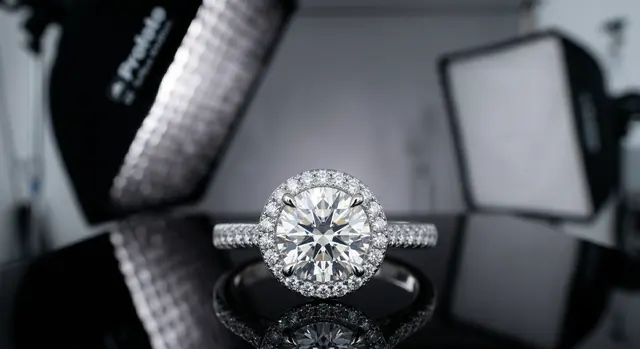
Sparkle and brilliance - the bright catchlights in a diamond’s table, the fire coming off a well-cut sapphire - are often softened or removed by AI smoothing passes. These are selling features. They need to stay.
Prong and bezel detail. AI background removers frequently produce mushy edges around fine prongs, cathedral settings, and pave work. The path mask needs a human check every time.
A Scalable Workflow
This is the sequence that keeps quality high without burning all the time savings AI offers.
Shoot clean
Use a lint roller and air blower before every setup. Every smudge caught on-set is one the AI does not have to guess at later.
AI background removal
Run the batch through your background remover of choice. Accept the results as a rough cut, not a finished mask.
Manual mask check
Zoom to 100% on prongs, chains, and any fine detail. Fix mushy edges with Refine Edge or a manual path where needed.
Color and contrast pass
Curves, Hue/Saturation, and selective color adjustments done by hand. This is where metal tones and gemstone accuracy get locked in.
AI spot cleanup
Use Photoshop’s Remove tool or Healing Brush with AI assist to clear dust, scratches, and micro-blemishes. Review each correction; undo anything that softens texture or removes intentional surface character.
Consistency check and export
View the whole batch together. Look for exposure drift, background color variation, and any piece where the metal tone looks off. Then export: JPEG for web, TIFF or layered PSD for archiving.
Tools Worth Using
- Photoshop (Remove tool, Generative Fill, Generative Expand) - the Remove tool handles dust and small blemishes well. Generative Fill is useful for extending or replacing backgrounds; Generative Expand helps when you need more canvas around a piece.
- Dedicated AI background removers (Remove.bg, Pixelcut, Evoto) - faster than Photoshop’s built-in Subject Select for large batches. Many support direct API access for automated pipelines.
- Lightroom batch presets - not AI, but essential for normalizing raw files before they hit any AI tool. Get the base exposure and white balance consistent first.
- Photoshop batch actions - automate the export and any repeated adjustments so the manual work stays focused on what actually needs eyes.
Keeping Color Honest
AI tools are trained on general photography, not on the specific spectral properties of precious metals and gemstones. This creates a consistent failure pattern: the AI “corrects” a slightly warm rose-gold tone toward neutral, or smooths out the color zoning in a sapphire because it looks like a flaw.
The fix is simple but requires discipline: keep a reference image of every piece shot under the same light, and compare it against the retouched file before delivery. If you are shooting for an e-commerce client, get a color-corrected reference approved by them on the first piece in a collection, then match everything else to that.
Also watch the shadows. AI background replacement can introduce background-colored color casts into shadow areas of the piece. Check the shadows in the reflected areas of any polished metal surface.
AI Pitfalls to Watch
- Over-smoothing. Brushed gold, hammered silver, and textured finishes are supposed to have surface variation. AI healing passes can flatten these into featureless gradients. Use a light touch and check texture.
- Lost reflections. Highly polished pieces pick up reflections from the shooting environment, including reflections that are part of what makes the piece look three-dimensional. AI background swaps can make these look wrong. Keep reflections that read as depth; remove ones that are distracting or color-inaccurate.
- Inconsistent edges across a batch. Even a good AI remover produces slightly different edge quality on different shapes. Review the full batch side by side before delivering.
- Halo artifacts. Background color bleeding along the edge of a cutout is a common AI tell. Easy to miss at small sizes; obvious on a product page. Check at 100% zoom.
- Fake sparkle. Some AI retouching tools add sparkle or gloss as an enhancement. This is not the actual piece. Turn those features off.
For the shooting side of the process - how to light and set up your shot so AI tools have less cleanup to do - see the guide to Etsy jewelry photography. For a broader overview of professional techniques, visit the jewelry photography hub.
Frequently Asked Questions
Can AI fully replace manual jewelry retouching?
Not yet - AI speeds up background removal and cleanup, but final color and metal detail still need a manual pass.
What tools work best for AI jewelry retouching?
Combine Photoshop's generative tools with a dedicated AI background remover, then finish by hand.
Related guides

Keep exploring: the complete guide, gear reviews, pricing, or find a photographer.