Pairing and Symmetry
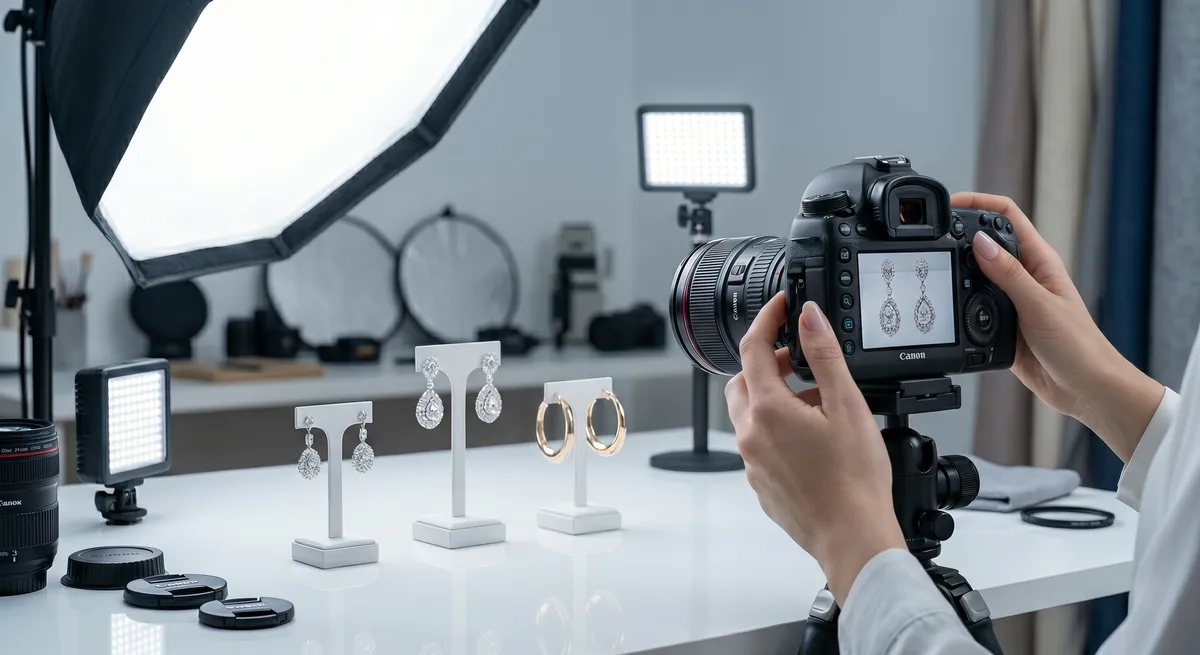
Earrings are sold and worn as a matched pair, so your photo has to read that way immediately. If one earring sits higher, rotates slightly, or catches more light than the other, the image looks careless and buyers start wondering whether the pair will arrive matched.
Before touching the camera, place both earrings at the same height and orient them identically. For drops and hoops, check that the dangle hangs at the same angle on each side. Step back and read the pair as a silhouette first.
Key takeaways
- Always shoot earrings as a matched pair: uneven height or rotation signals poor quality.
- The display method changes by type: hang drops and hoops, lay studs flat or at a slight angle.
- Soft diffused light eliminates hotspots on metal and lets stone color read accurately.
- A macro shot of the post, hook, or stone setting is essential for fine jewelry listings.
Use a tripod and level the camera head so your shooting axis is centered on the pair. Even a slight downward tilt makes one earring appear larger than the other.
Display Methods
Earrings have no flat base to stand on, so how you hold them up is half the technical challenge.
Clear Acrylic Stand
A small acrylic T-bar or earring display card holds both hooks at the same height and stays invisible in the frame. The earrings hang freely and show the full dangle.
Fishing Line
Transparent monofilament tied between two out-of-frame anchors gives drop earrings the appearance of floating. Against a white background the line disappears in post with minimal work.
Flat Lay for Studs
Studs sit well directly on a clean surface: white acrylic, frosted glass, or textured paper. Angle them very slightly so the post is not pointing straight at the lens. A small piece of museum putty keeps each one stable.
Earring Card
A branded paper earring card holds both pieces at a fixed spacing and adds a packaging context useful for secondary listing shots.
Keep the display invisible or fully intentional. An acrylic stand that is only partially visible is more distracting than one that is completely in frame.
Studs vs Drops vs Hoops
Each type has different shooting priorities.
Studs are small and detailed at the face. A wide shot loses the prong work, stone facets, and surface finish that justify the price. Get close with a macro lens or extension tube and shoot from slightly above so the post stays out of the dominant plane.
Drop earrings earn their appeal from movement and hang. Suspending them on a stand or line lets gravity do the work. Shoot from the front and then a three-quarter angle to show depth, especially if the piece has multiple tiers or articulated links.
Hoops are the trickiest for symmetry because the circle is sensitive to even a one-degree tilt. A front-on shot renders them as ovals, which can look squashed. A slight three-quarter angle shows the round profile more honestly.
Lighting
Earrings combine the two hardest materials: polished metal and small faceted stones. Metal picks up every hard source as a hotspot. Stones go dark or blown depending on angle.
A large softbox at least 60 cm wide at roughly 45 degrees above and to the side wraps around curved metal without creating a blown specular and drives light into stone facets. Add a white fill card opposite to open the shadow face. Angle the key so it enters the stone pavilion from above, making the gem glow rather than just reflecting off the table facet.
Avoid ring flash. Frontal light flattens the three-dimensional quality of settings and stone cuts.
On-Model vs Product Shots
A plain background product shot earns the click. An on-model shot closes the sale.
On-ear images answer the questions that stall purchases: actual size, how the piece hangs against skin, and whether it moves the way the buyer imagines. Use a model with hair back so both earrings are visible, and match the light quality to your product shots.
For product frames, keep both earrings on a clean white or off-white background. Shoot the product setup first to lock down the light, then bring in a model before breaking the setup down.
Macro Detail
Include at least one close macro in every listing: stone setting and prong count for fine jewelry, wire wrap or bead placement for handmade pieces.
Move in until the detail fills the frame and stop down to f/11 for adequate depth. The post and hook should appear in at least one frame so buyers understand how the earring is worn. No macro lens required: inexpensive extension tubes on a standard 50 mm get close enough for most earring work.
For the same approach applied to chains and pendants, see How to Photograph Necklaces. For listing-specific image guidance, see Etsy Jewelry Photography. For a full lighting reference, visit the Jewelry Photography hub.
Frequently Asked Questions
How do I display earrings for photos?
Hang drop and hoop earrings on clear acrylic or fishing line to show how they hang, or lay studs flat or angled on a clean surface. Always show them as a matched pair.
Should I shoot earrings on a model?
On-model or on-ear shots show scale and how they hang, which helps buyers. Pair them with clean product shots on a plain background for the listing.
Related guides
Keep exploring: the complete guide, gear reviews, pricing, or find a photographer.